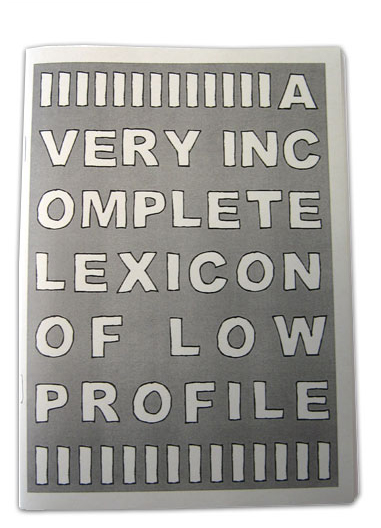
DOWNLOAD:
A Very Incomplete Lexicon of Low Profile in pdf format
(19 pages)
Foreword
I have been involved in a process of interrogating the words I use to tag or label areas of the practice and research I am busy with and invested in - both drawing attention to and identifying the areas, issues, concerns and/or words that need attending to. My attending to these terms provides a space that is both generative - allowing me to think more deeply about/around the work, opening up a space and time to work things out through writing – and simultaneously descriptive or about explaining. These are words that act as a focus to gradually make things clearer.
I would like to use this lexicon as a way to frame up this interrogation (searching for, finding, close questioning and unpacking) of terms as a methodological approach, gathering together (and presenting) some of the words that have a particular use-value for me, or us as LOW PROFILE (satisfying a need or want), and for others (realised in the process of consumption – through writing, presenting, reading, listening, talking about, exchange and re-presentation). It functions (as a lexicon) both as a container for words belonging to the same language and as a way to make visible the organising of a mental vocabulary in the speaker’s mind - a way to organise and present scattered thoughts, translating them into a written format.
Lastly nothing can have value, without being an object of utility. If the thing is useless, so is the labour contained in it; the labour does not count as labour, and therefore creates no value.
(Marx: 1867, Vol. I, end of Section 1)
This process of developing a vocabulary for discourse around the area of research/inquiry is undertaken in the hope that attending to (spending time/effort/labour focusing on) these words endows them with a particular usefulness – what Marx terms a ‘social use value’ (Marx: 1867). In my case, this process is not solely contained in the space of writing – I find that the practice itself (the making/showing of live work and ephemera) is helping to develop the vocabulary, and that the vocabulary is helping to develop the practice.
At this point, in may be worth identifying/unpacking my interest in using “common” words – words that already hold a shared meaning within language – as a way to unpick and further investigate this extended practice I am involved in. These are words that are intended not to exclude. As with the work I make as part of LOW PROFILE, in my writing I am invested in (committed to, and engrossed by) making reference to, and use of, things/words that are used by ordinary people (like myself); things that do not require a specialist knowledge or suggest a special privilege, rank or status; things that do not require a specialist glossary or explanation; things that instead imply what Rancière calls an ‘equality of intelligences’ (Rancière: 2007) – a situation where author and reader or artist and audience share a space of investigation focusing on something that is in some way ‘foreign’ to both.
In this sense, I offer this lexicon, not as a glossary that defines terms, or as an attempt to master these words, but as a space for a re-negotiation of meaning and use-value of these words - for reader and author to approach these shared yet ‘foreign’ words. I hope that it can act as a space in which to unpack and re-present this process of ‘reclamation’ I am involved in - this attending to (and caring for) things that might otherwise be overlooked – and the strength of the activity of searching for/finding/using these words.
Rachel Dobbs
(LOW PROFILE)
2009
* * *
References:
Marx, Karl (1867) Das Kapital - Vol. I, end of Section 1, Chapter 1
(available online at http://www.marxists.org/archive/marx/works/1867-c1/ch01.htm)
Rancière, Jacques (2007) ‘The Emancipated Spectator’ Artforum International, March 2007, pp 271 – 280
read more...
DOWNLOAD the full document:
A Very Incomplete Lexicon of Low Profile in pdf format
(19 pages)

this work by Rachel Dobbs & LOW PROFILE
is licensed under a Creative Commons License.
research has been supported by AHRC
and undertaken as part of the MACAPD
programme at Dartington College of Arts
(University College Falmouth)
for more information about LOW PROFILE
see www.we-are-low-profile.com
return to rachel's page on the LOW PROFILE site